My stage of the Tour de France
Author: Sarah Larkham
04 August 2026
My stage of the Tour de France
L’Étape du Tour de France gives amateur cyclists the rare chance to experience one stage of the Tour de France for themselves, following in the wheel tracks of the 23 professional teams and 184 riders. This year, more than 16,000 participants from around the world took on what is widely regarded as one of the toughest routes in the event’s history: 170km from Bourg-d’Oisans, with 5,400m of elevation gain.
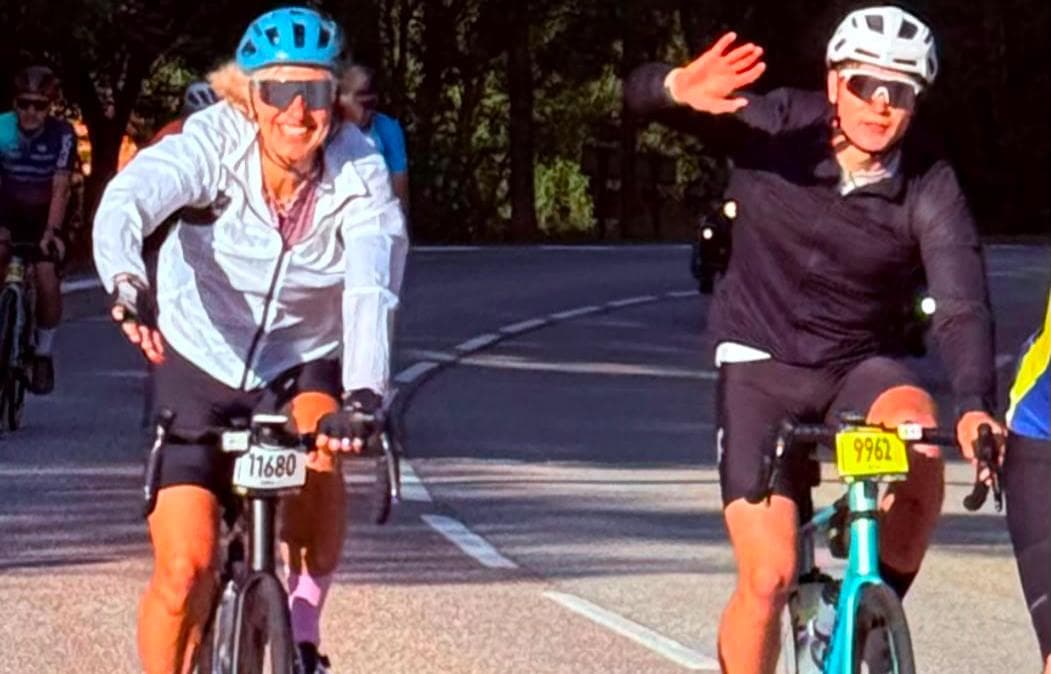
My son and I had been given a 7:48am start time in Pen 11; the first riders had set off at 6:30am. As we headed towards the start, tension began to build as we tried to drop off bags, find friends and reach our pen with enough time to spare—while also navigating the toilet queue. With women making up less than 5% of the start line, the facilities were a “free-for-all”, so long queues, wet seats and no loo roll did not make for the most encouraging start.
As we rolled the bikes through town towards the start line, the atmosphere felt friendly and unusually calm. We crossed the line without drama and settled into a comfortable pace on the flat—a welcome opening stretch, especially with far too many riders around us to risk starting fast. The streets were already lined with families, friends and the familiar frenzy of Tour fans.
We rode through beautiful Allemond, climbing gently towards the lake—a useful warm-up before the first of our four climbs: the Col de la Croix de Fer, an Hors Catégorie ascent to 2,067m (24km at 5.2%). The early section was narrow and, even on closed roads, fitting 16,000 riders onto the course was a challenge. Everyone was trying to find a rhythm, settle into the long grind and follow the cycling code of keeping right so faster riders could pass. As with UK motorway driving, however, moving into the slow lane does not come naturally to everyone, so it took concentration to avoid sudden swerves or catching a wheel. Once I found my pace and controlled my breathing, I settled into a stunning climb through forest, past a huge dam and beautiful villages, before reaching the top of the Col and being rewarded with a fast descent to Saint-Sorlin-d’Arves. Everything was going well, and I felt strong, until halfway down the descent we came to an abrupt halt and were guided to one side of the road. There, we sadly passed a bike accident, with blood on the road and ambulance crews and police nearby. It was a stark reminder that, with so many people on the course, caution and respect were essential, and that it was important not to get carried away by the occasion. It took a while to settle again, and I was relieved that the next 30–40km involved more “normal” cycling rather than the aggressive switchbacks and climbs of the Alps.
As the road eased for 10–15km, I tucked into a large group to conserve energy for the next challenge: the Col du Télégraphe, a steady climb to 1,566m over 11.9km at an average gradient of 7.1%. In hindsight, I remember little of the climb itself beyond the large arch at the start. What I hadn’t appreciated was that the Col is merely a warmup to the next climb, the Hors Categorie,; Col du Galibier, 2,642m (17.7km @ 6.9%). With 70km remaining, we stopped for refreshments at the foot of Galibier and fuelled up before starting our climb. I was tired, hot but ready, however, on reflection I had only stopped once for a pee and still had water in my bottles! Dehydration=Cramps! Galibier has a moderate start along the river and open winding roads, followed by a severe final 8 km averaging 8.5% to 9 % through barren rock and tight switchbacks. It reminded me of the Scottish mountains but without the rain! It was stunning and I was enjoying the views until the cramps came, thick and fast. I cannot describe the horrendous pain in the hamstrings and across the thigh and groin which would come in waves forcing me off the bike, if I was able to unclip in sufficient time. The last 5km became so painful I wanted to run rather than cycle but my son telling me to get on with it and other riders encouraging me to get back on the bike, all aided me to the top. My cramps however, cost me a lot of time and where we had been over an hour ahead of the broom wagon at the start of the climb, we now had only 15 mins to spare to the last cut-off and then onto the last climb up the Col de Sarenne, 1999m (12.8km @ 7.3%). To add to our challenges, they had run out of water at the top of Galibier, so we needed a quick stop to top up before reaching the cut-off. My fastest downhill ever!
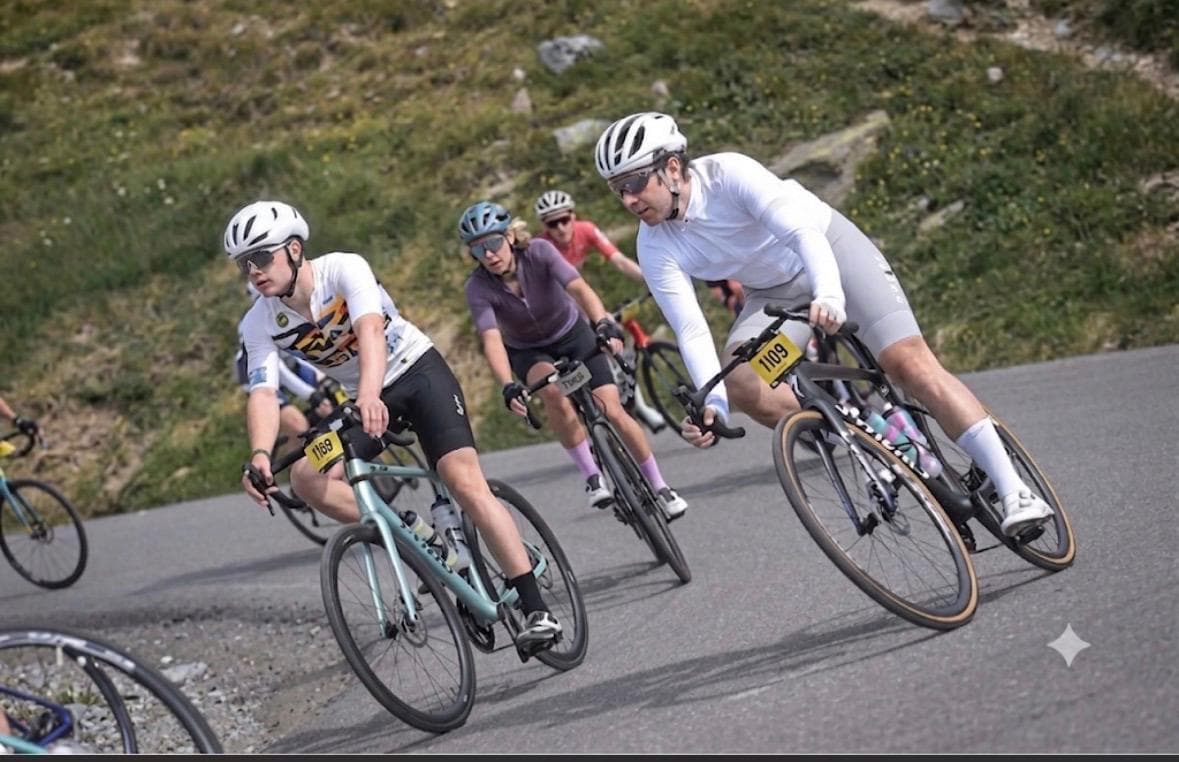
The Col de Sarenne approaches Alpe d’Huez from the back, the final climb of the day, where Carapaz won the stage after Sepp Kuss crashed his bike twice on the descent to Huez, a week later. After crossing the last cut off at the bottom of the Col, knowing we could now complete in the time, we approached the climb with renewed vigour and, in fact, completed our fastest Col of the day! It wasn’t pretty but the stats on this day became irrelevant. We completed the course. The final 3km climb into Alpe d’Huez felt cruel and long but we made it.
Would I do it again – YES! Despite the pain and grind, it was stunning an unforgettable experience.
Sarah L, the masochist.